


Confidence before and after purchase comes from transparency. LatestCram shows the demo first, publishes the refund terms plainly, and answers questions around the clock.
ECCouncil 312-97 Exam Syllabus Topics:
| Section | Objectives |
|---|---|
| DevSecOps Pipeline - Release & Deploy Stage | - Configuration management security - Policy as Code implementation - Orchestration and deployment security - Infrastructure as Code (IaC) security |
| DevSecOps Governance and Culture | - Continuous improvement practices - Security policy and framework - Team roles and responsibilities - DevSecOps maturity model |
| Understanding DevOps Culture | - Collaboration and communication models - DevOps lifecycle and workflows - DevOps fundamentals and principles |
| DevSecOps Pipeline - Build Stage | - Automated build security - Software Composition Analysis (SCA) - Container security fundamentals - Build pipeline security controls |
| DevSecOps Pipeline - Operate & Monitor Stage | - Threat detection and response - Continuous security monitoring - Logging and security analytics - Incident response and management |
| DevSecOps Pipeline - Plan Stage | - Risk assessment and management - Threat modeling methodologies - Security requirement engineering - Compliance and regulatory alignment |
| Cloud-Native DevSecOps | - Cloud security principles (AWS, Azure) - Serverless security - Cloud security compliance - Container and Kubernetes security |
| DevSecOps Pipeline - Code Stage | - Secure coding practices and guidelines - Static Application Security Testing (SAST) - Secret management and prevention - Code review and security analysis |
| Introduction to DevSecOps | - DevSecOps vs traditional security - Shift-left security approach - DevSecOps concepts and philosophy - Key components and toolchain |
| DevSecOps Pipeline - Test Stage | - Interactive Application Security Testing (IAST) - Security regression testing - Dynamic Application Security Testing (DAST) - API security testing |
312-97 Exam FAQ — Install Anywhere, Learn Everywhere
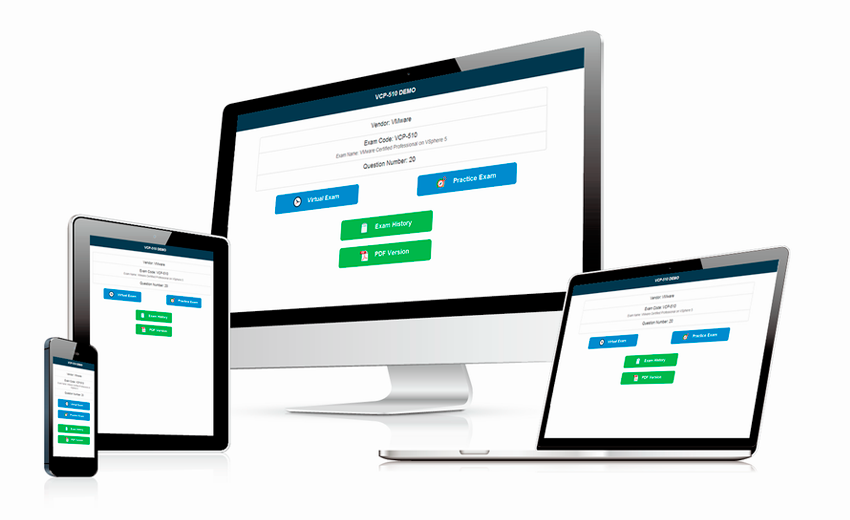
Three versions of the same study materials: a printable, expert-prepared PDF with free demo download and instant access; a Desktop Test Engine for Windows with customizable simulation and timed modes that works offline; and an Online Test Engine for any browser on Windows, Mac, Android, and iOS with test history and performance review. All 150 practice questions are identical across versions. Every purchase includes 365 days of free updates, a 50% renewal discount afterward, and unlimited computer installations.
The ECCouncil EC-Council Certified DevSecOps Engineer (ECDE) exam requires 70% to pass, and registration costs $550 USD. A failed attempt means paying the same fee again — a readiness check with the LatestCram engines before booking is the cheaper option.
The 312-97 exam is a ECCouncil certification exam validating the ECCouncil EC-Council Certified DevSecOps Engineer (ECDE) syllabus shown above. Candidates in 2026 start with LatestCram's 150 practice questions, available as a printable PDF, a Windows Desktop Test Engine, and an Online Test Engine — three versions of the same materials.
LatestCram issues a full refund if you take the ECCouncil EC-Council Certified DevSecOps Engineer (ECDE) exam within 60 days of purchase and do not pass. The policy does not apply if the exam is taken within 3 days of purchase, if the exam was never actually taken, or to free materials or expired orders, and the candidate name must match the payer name. Submit a scan of your enrollment slip and the official Score Report PDF within 2 days of the exam; claims are processed within 7 days. Alternatively, exchange for two free exam products of equal value and keep your original update service. Orders arrive by email within 1 minute — contact support if nothing arrives within 2 hours.
The official ECCouncil EC-Council Certified DevSecOps Engineer (ECDE) outline defines 10 domains. The leading three are DevSecOps Governance and Culture, DevSecOps Pipeline - Plan Stage, and DevSecOps Pipeline - Build Stage. The full list is in the topics section above, and LatestCram's 150 practice questions cover each one.
2 years of work experience in information security domain if not attending official training; $100 USD non-refundable application fee required Since requirements change over time, confirm the latest on the official ECCouncil exam page before scheduling.
The ECCouncil EC-Council Certified DevSecOps Engineer (ECDE) exam contains 100 to complete within 240 minutes. Timed simulation in the LatestCram Desktop Test Engine teaches that rhythm before exam day does.
ECCouncil recommends these training resources for the ECCouncil EC-Council Certified DevSecOps Engineer (ECDE) exam:
Follow the training with steady self-testing — the 150 practice questions from LatestCram help you apply theory and fill any gaps the training leaves.
Online via EC-Council Exam Portal or ECC Exam Center Register for the ECCouncil EC-Council Certified DevSecOps Engineer (ECDE) exam through these official channels:
After booking, LatestCram delivers your practice questions within 1 minute — preparation starts the same day.
ECCouncil EC-Council Certified DevSecOps Engineer (ECDE) Sample Questions:
Emily Johnson, a DevSecOps Engineer at TechSupport Solutions, is responsible for securing the code repositories of a customer support software platform. To enhance security, she decides to integrate Snyk with AWS CodeCommit to monitor and remediate vulnerabilities in the stored code. Emily configures an Amazon EventBridge Rule to trigger AWS CodePipeline whenever new code is pushed to AWS CodeCommit. The pipeline then invokes a security scanning process, where Snyk CLI is executed to analyze the code for vulnerabilities. Once Snyk CLI completes the security scan, the results are sent to Snyk UI for further analysis and tracking. Which of the following AWS services interacts with Snyk CLI and sends the results to Snyk UI?
- A. AWS CodePipeline.
- B. AWS CodeDeploy.
- C. AWS CodeCommit.
- D. AWS CodeBuild.
Correct Answer: D 🗳️
Explanation: Only visible for LatestCram members. You can sign-up / login (it's free).
Cindy Williams has recently joined an IT company as a DevSecOps engineer. She configured Bundle-Audit in Travis CI. Cindy detected vulnerability in Gemfile dependencies and resolved it by adding some line of codes. How does Bundler scan Gemfile.lock for insecure versions of gems?
- A. By taking the information from the Gemfile and comparing it with the unknown vulnerabilities.
- B. By taking the information from the travis.yml and comparing it with the unknown vulnerabilities.
- C. By taking the information from the Gemfile and comparing it with the known vulnerabilities.
- D. By taking the information from the travis.yml file and comparing it with the known vulnerabilities.
Correct Answer: C 🗳️
Explanation: Only visible for LatestCram members. You can sign-up / login (it's free).
A software development company relies on Jenkins to automate its CI/CD workflows. Recently, the DevOps team identified a need for a new plugin that would improve Jenkins maintainability and reliability, ensure critical data is retained for future use, support scheduled operations to improve workflow management, and provide flexibility in configuring what is stored Which Jenkins plugin would best suit their needs?
- A. Pipeline.
- B. Performance Publisher.
- C. Job DSL.
- D. ThinBackup.
Correct Answer: D 🗳️
Explanation: Only visible for LatestCram members. You can sign-up / login (it's free).
William McDougall has been working as a DevSecOps engineer in an IT company located in Sacramento, California. His organization has been using Microsoft Azure DevOps service to develop software products securely and quickly. To take proactive decisions related to security issues and to reduce the overall security risk, William would like to integrate ThreatModeler with Azure Pipelines. How can ThreatModeler be integrated with Azure Pipelines and made a part of William's organization DevSecOps pipeline?
- A. By using a unidirectional UI.
- B. By using a bidirectional UI.
- C. By using a unidirectional API.
- D. By using a bidirectional API.
Correct Answer: D 🗳️
Explanation: Only visible for LatestCram members. You can sign-up / login (it's free).
A DevSecOps engineer is configuring Chef InSpec to perform security compliance checks on an Azure environment. The engineer needs to authenticate with azure using a Service Principal Name (SPN), execute InSpec scans against the Azure environment and Ensure authentication is handled securely and efficiently. Which is the best way to configure authentication before running the InSpec scan?
- A. Manually enter Azure credentials every time before running an InSpec scan.
- B. Store Azure credentials in the ~/.azure/credentials file and execute inspec exec azure_profile -t azure://.
- C. Authenticate using the Azure CLI before every InSpec execution without storing credentials.
- D. Use only AZURE_SUBSCRIPTION_ID as an environment variable to authenticate.
Correct Answer: B 🗳️
Explanation: Only visible for LatestCram members. You can sign-up / login (it's free).
Viewing page 1 out of 30 pages.
Viewing questions 1-5 out of 150 questions.


 1061 Customer Reviews


